Tuesday, 7 August 2012

Walking in a wader wonderland

 The mighty Longstone in stunning light

Golden Plovers continue to increase in number 

Huge numbers of Turnstone present 
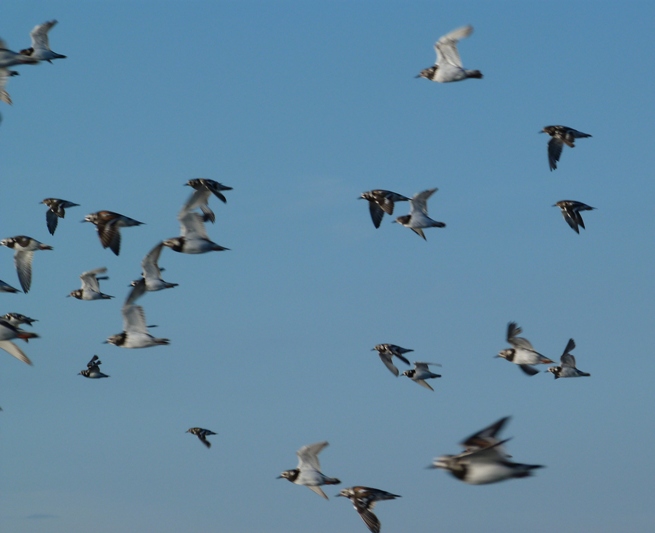
Wader action

Tuesday 7th August comments: Today brought yet more glorious sunshine as the Farnes are basking in the weather we wished for just a few months ago. The seabirds continue to prepare for departure whilst incoming wader numbers continue to increase with some impressive totals including over 700 Turnstone, 400 Golden Plover and 150 Purple Sandpiper.

As wader passage peaks, a few more interesting species have been recorded including three Greenshank together, a stunning summer plumage Grey Plover and a scattering of juvenile Dunlin. Small passerine migrants are also starting to appear with ten Willow Warblers although yesterdays monster Barred Warbler had moved on to pastures new. Its been a good start to the 'autumn' (its autumn for birds - honest!) and we hope to bring you many more highlights over the next few months. Fingers crossed.

Monday, 6 August 2012

Happy as Barry


August sunset (Will Scott) 

Sandwich terns continue to build on the rocks (Will Scott) 

 Sandwich Terns in flight (Will Scott)

Our last Arctic tern chick growing up strong


Monday 6th August comments: It’s been a cracking day on the Farnes for plenty of reasons, including the first August blog update (sorry I’ve been away for a short-break). The islands are looking good and despite the majority of our breeding seabirds moving away off the islands, we still have a few birds remaining including Shags and Kittiwakes whilst groups of Arctic and Sandwich Terns continue to linger. A small number of Puffins are still bringing food back to hungry youngsters but be warned only a handful remain.

Today also signalled the start of the autumn migration (yes the autumn is here in birding terms!) as the islands produced a monster; our first BARRED WARBLER. The bird exploded from vegetation on Brownsman and showed until dusk and represents our earliest ever record. The excitement didn’t stop there as we also bagged ourselves a Black Redstart, a handful of Willow Warblers and an adult Black Tern. The birding autumn has begun and stay with us

Tuesday, 31 July 2012

Winging it


Pufflings already heading out to the open sea


Sandwich Terns getting itchy feet and preparing to leave

Arctic Tern chicks get their last feed before heading down to the other end of the planet!


Tuesday 31st July comments: It’s still all go on the islands, with the remaining breeding birds giving that one final push to get their chicks ready for their first flight. The birds on the Farnes have an epic journey ahead of them, with many of them covering thousands of miles, over turbulent seas and through stormy skies.

The Guillemots and Razorbills that have spent the past few months clinging to the cliff faces are now well on their way out to their favourite wintering spots in offshore waters of the North Sea, the chicks now able to fend for themselves and feeding off the local catch! The Puffins, already off the islands and in the water, will similarly soon be heading out into the open ocean, some even heading around the north of Scotland into the north Atlantic.

But our hardest-going fliers have to be our terns. Our Sandwich Terns are getting restless, flying back and forth over the island with their chicks closely following, and they’ll soon be heading down to west Africa to spend our winter in the warmth! Our Arctic Terns, however, will be heading even further down the west coast of Africa all the way to Antarctica, chasing the eternal sun to spend the southern summer down in the rich Southern Ocean.  This includes our chicks, hatched only a month and a half ago, who will be learning the route en-route from their knowledgeable parents.

And then in 8 months time, they’ll all be back again to try once more out on these productive islands.  It really is an amazing feat of nature, and one that we, and you, can enjoy every year on Planet Farne!

Friday, 27 July 2012

Wade a minute...


Turnstone showing in good numbers (Ciaran Hatsell)


Doing well - two of our resident ringed plover chicks (Ciaran Hatsell)

Dunlin with a difference - any suggestions of where this beauty has come from?


Friday 27th July comments: So, as the breeding season slowly but surely comes to an end (still several species feeding young including Puffins, but hurry up!), our attentions turn elsewhere as we look at other wild and wonderful things surrounding the Farne Islands.

At this time of year we start to notice a big increase in the number of wading birds around the islands, with huge congregations of birds like Golden Plover, Purple Sandpiper and Turnstone becoming regular fixtures on our rocky coastline. Some of these birds are returning from breeding as far north as Greenland and even Arctic Canada, some epic over-sea migrations see them finally touch down on the mighty Farnes. In the last week we have seen several species such as Curlew, Whimbrel, Black and Bar-tailed Godwit, Knot, Redshank, Dunlin, Purple Sandpiper and Green Sandpiper (Phew!). All these birds are specially adapted to exploit different food sources, waders really are a diverse and fascinating family of birds!

It’s also getting into the best time to see that rare British breeder the Roseate Tern, as family parties start to congregate in the Tern roosts by the jetty; ask a Ranger and we’ll do our best to pick one out for you! With Butterfly numbers building, a great variety of moths on show and a tank full of marine creepy crawlies from Hermit Crabs to Starfish, it really is a great time to visit the Farnes!

This weekend the island are also taking part in the country-wide Seawatch event this Saturday and Sunday, so why not come out and see what you can spot with us?! Will it be a Minke Whale? A Porpoise? Or even a pod of Dolphins? Ladies and Gentlemen, grab your telescopes, let the seawatch begin!

Wednesday, 25 July 2012

Under the sea

A brittlestar works its way across the rocks
Two beautiful Polycera quadrilineata nudibranchs

Don't worry, it's only an inch long - A Caprellid skeleton shrimp waits for passing food

Wednesday 25th July comments: Where would our seabirds be without the sea? It’s not just the bird life around the islands that is amazing, the critters that live under the waves can be equally interesting too, and I’m not just talking about seals!

The rocky-shore life around the Farnes is particularly rich, with numerous Sea Hares (actually a type of sea slug), nudibranchs, limpets, starfish, crabs, and other marine invertebrates all calling these vibrant waters home not to mention the fish! Strange mantis-like skeleton shrimp cling to the algae, grabbing passing food particles with oversized claws, and barnacles waft their modified legs to filter feed.

This August, the ranger team will be scouring the rocks at low tide to show you some of these marvellous creatures up close, to give you an idea of just how rich the wildlife of the Farnes waters is.

The team is also looking forward to their big seawatch this weekend as part of the National Whale and Dolphin Watch, organised by the Seawatch Foundation. The team shall set up a constant vigil of the farnes waters from Friday 27th till Sunday 29th July, looking out for cetaceans (and of course any birds that may pass too...) With the Farnes being one of the best seawatching spots on the Northumberland coast, you’re welcome to come along join in, either with your own scope or with one that we’ve set up, and we hope to see you there!

Sunday, 22 July 2012

Moth Mayhem


Farnes breeder; Garden Tiger 

Monster moth: Poplar Hawk-moth 

Antler Moth 

Angle Shades 

Small magpie

Sunday 22nd July comments: Its not all about birds on the Farne Islands as this time of year heralds the start of other recording; most noticeably Lepidoptera. It appears we're heading for a bad year for butterflies, but moth recording has taken off and already we’ve had some impressive discoveries.

Lead by resident ranger Will Scott, a good number of impressive moths have been caught and identified (everything is released unharmed after counting), and with some potentially good weather on the horizon August could yet bring even more surprises.

As part of the August visitor activities on the islands, we’ll be opening the moth traps during visitor hours to show people some of the goodies we have caught overnight. As the ranger motto goes; “if it moves, we record it”.

Saturday, 21 July 2012

Mother Carey's Chickens


Nets being set ready for evening bird ringing 

Nets ready across pic-nic site on Inner Farne 

Sound system ready 

Bingo - our first Storm Petrel caught, ringed and released unharmed (Will Scott) 

White rump on display

Saturday 21st July comments: It was a late night last night as the team went about ringing a very special seabird; the Storm Petrel. These little nocturnal flyers are seen in small numbers down the English east coast with the nearest breeding colonies as far away as Shetland and the northern isles. However nocturnal tape luring can bring birds close to shore and with the aid of mist nets and a tape lure, birds are caught on annual basis in small numbers. Last night, three Storm Petrels were caught and ringed on Inner Farne between 1-2am and hopefully a few more will be trapped over the next few weeks. It's seawatch time.