Tuesday, 18 September 2012

Blasts from the past


Brownsmans 1995 Lanceolated Warbler

 Hornemanni Arctic Redpoll in 2010

One of eight September Yellow-breasted Buntings recorded on Farnes 

September on the Farnes; Olive-backed Pipit

Tuesday 18th September comments: It’s been a very quiet spell for migrant birds over the last three weeks as the westerly winds have dominated. September is peak time for migration as birds, both young and old, are moving south from the Northern Hemisphere (approx 4 billion birds migrate south annually from Europe).

However migration stations like the Farne Islands rely on favourable winds ‘dropping’ birds – so any hint of east in the wind will quicken the pulse of the birders on the islands. However the worst weather for bringing migrants to the islands are westerlies and they have dominated over the last three weeks bringing very little with it.

So to cheer us all up, here is a gentle reminder of the good birds that the Farnes have produced in previous Septembers…

The month has produced some stunning seawatching including no fewer than three Fea’s-type Petrels as well as past glories of both Cory’s and Great Shearwater sitting together on the sea in 2002. The major ‘mega’s of September included both the islands Lanceolated Warblers on 16th-17th September 1995 and 29th September 2009 alongside eight Yellow-breasted Buntings, the islands only Red-flanked Bluetail in 1998, and a Hornemanni Arctic Redpoll in 2010. Other good birds to wet the appetite include Red-footed Falcon, White-rumped Sandpiper, Citrine Wagtails, Tawny Pipits and Olive-backed Pipits.

However nothing can beat the real rarity star of previous Septembers on the Farne Islands…our one and only (ever) BLUE TIT recorded in September 1977. Mega.  The month of September can be amazing but we need this wind to alter and maybe we’ll be in with a shout. Fingers crossed.

Sunday, 16 September 2012

Cuthbert's Swallows


Swallow chick almost ready to fledge (Bex Outram) 

Chick being ringed (Bex Outram) 

Home for the Swallows...St.Cuthbert's Chapel

Sunday 16th September comments: As the westerly winds continue to dominate (resulting in very few migrants birds to report), the team continue to work effortlessly behind the scenes. On the management front, the old Staple boardwalk is completely gone (ready for new replacement), a fenceline running the length of Brownsman has been complete and all the strimming work is now complete on Inner Farne. The team are kept busy even with our visitors arriving daily.

As well as all the management work, we continue to carry out scientific studies, especially bird ringing. Yesterday the team ringed the two Swallow chicks in St.Cuthbert’s chapel, the second brood of the summer, which are ready to fly any day soon. It’s been a good year for our breeding Swallows, as four pairs have bred across the islands including pairs nesting in the Chapel and the two lighthouses (Longstone and Inner Farne). It has been a change in fortunes for this aerial summer visitor, as up until two years ago, Swallows had not bred on the islands in 12 years, so it’s a very welcome return to form.

Friday, 14 September 2012

Noisy Neighbours


Once hit, never forgot...an Arctic Tern on the Farnes 

Food supply was excellent this year 

Silver ghost... 

Up close and personal 

Friday 14th September comments: In the latest seabird review, we take a closer look at our ‘noisy neighbours’ the Arctic Terns...


The first Arctic Terns started arriving in Farne waters from mid-April and aerial courtship displays soon followed, with the first eggs discovered on 13th May (an average laying date). The population remained stable on the Farnes with a slight increase on the previous year with 1,866 pairs nesting (an increase of 36 pairs on 2011). The following figures represent the total number of breeding pairs per island, with the bracketed figures representing the breeding totals for the previous season: Inner Farne 1,282 (1,170), Staple 11 (0) and Brownsman 573 (660).

The ranger staff monitored 1,010 nests (representing 55% of the population) which produced 654 fledged young (an overall productivity rate of 0.65). Once again, the highly disturbed courtyard on Inner Farne remained the most productive – the presence of visitors keeping away predatory Gulls, resulting in some excellent returns from that area. In other more exposed areas of the colony (away from the public) predation levels were high. This tactic works well for Arctic Terns, as they prefer to nest near high disturbance areas – something which surprises many people!

Elsewhere the colony within the lighthouse compound on Inner Farne continues to increase in size as the first few pairs nested in 2009 increasing to this years impressive 246 pairs. Overall, food supply was excellent (one of the best in recent years) with breeding success only being limited by the weather, as heavy rain and below average temperatures resulting in small chicks succumbing to the elements.

Overall, it was a difficult year for Arctic Terns, with poor weather at the wrong time of year (June-July) resulting in reduced breeding success although despite this (it could have been a lot worse), as a good number of chicks still went on to fledge.

Wednesday, 12 September 2012

Gannin for a Frenzy


Gannets galore around the islands (Bex Outram) 

Gannet feeding time (Bex Outram)

Gannets heading in (Bex Outram) 

Juvenile Gannets now on the wing

Wednesday 12th September comments: It’s been another pleasant day on the islands as the westerly winds continue to dominate producing bright sunny conditions. In recent days, huge numbers of Gannets have been gathering in Farne waters as a variety of fish move closer to shore. This has resulted in large feeding frenzies involving over 3,000 Gannets supported by up to fifty Sooty Shearwaters and plenty of Fulmars amongst others.

The frenzy continued for several hours today and was a real treat for rangers and visitors alike as birds circled in dense flocks before plunge diving like torpedoes into the sea. These spectacular birds, the largest British seabird, remained active despite the presence of boats and with Minke Whale being sighted in the area, it may just get a lot better over the next day or two.

Tuesday, 11 September 2012

Steady season for Shags


Up close - stunning head of a Shag 

Keep away..Shag at nest 

Large healthy young with adult 

Bird ringing with Shag 'darvics' ready for use 

Sunset over the colonies

Tuesday 11th September comments: In the latest series of seabird reviews, we take a closer look at the Shag and the season it experienced on the Farnes this year. The species remains one of the very few which remain around the island all year round as large groups can be seen loafing on several islands throughout the winter months. Following a mild start to spring, the first eggs were discovered on 23 March, matching the previous earliest ever laying dates set in 2003 and 2011. Following this rapid start, a good number of nests with eggs were recorded by the end of March.

Encouragingly the population increased for a fourth consecutive year with 965 pairs nesting, an increase of 4% from the previous season. The following figures represent the total number of breeding pairs per island, with the bracketed figures representing the breeding totals for the previous season: Inner Farne 263 (273), West Wideopens 92 (80), East Wideopens 88 (86), Megstone 19 (18), Skeny Scar 62 (52), Staple 162 (158), Brownsman 108 (103), North Wamses 42 (28), South Wamses 41 (51), Rodham and Green 5 (10), Big Harcar 64 (50) and Longstone End 19 (17).

As was the case this season, the weather caused issues across the colonies as large young (from the early nesters) were unable to shelter under their parents and succumbed to the elements (especially the rain). Despite this, the ranger staff monitored 344 nests (staff monitored 36% of the population) which produced 356 fledged young. This result gives an overall ‘productivity’ of 1.03 (compared to 1.41 last year). Despite the slight decrease in overall productivity, this years figure was still well above the average levels of ten years ago.

For the fourth consecutive year, the colour ringing study continued with over 100 new birds fitted with ‘darvic rings’; making them easily identifiable as individuals and to allow field observations to identify birds. A pair illustrated some interesting information on the dispersal along the east coast of Britain as a male carrying a red darvic (ringed on the Farnes) paired with a female carrying a yellow darvic (ringed on the Isle of May) and successfully raised young on Staple Island.

In conclusion, Shags had a reasonable season, with the population increasing and steady productivity, something we could only have hoped for considering the weather we had this summer.

Monday, 10 September 2012

Yanky Double Dandy


Wigeon on the move today 

Arctic Skua - one of five logged on passage 

Peregrines back resident for the autumn on the islands

Monday 10th September comments: Westerly winds can be perceived as being dull, bringing very little bird migration to the islands. However it can also be wrong, as today proved. An early morning seawatch revealed a steady movement of wildfowl past the islands which included the first returning ‘pale-bellied’ Brent Geese of the autumn, as birds moved to nearby Lindisfarne for the winter. Supporting cast included all three Diver species noted, our first autumn Goldeneye alongside reasonable counts of Teal and Wigeon.

However all this was overshadowed just after 08:30 when two (yes TWO) adult SABINE’S GULLS were observed flying south together. Both birds were associating with several Kittiwakes and even stopped to join a feeding party of Terns/Kittiwakes (and landing on the sea) before eventually continuing their journey south. This impressive sight was witnessed by all the team, so it was a great start to the day and represents the 26th-27th records for the Farne Islands (the first was as recent as August 1991). Since then, both 1997 and 2005 have produced five in a year, so anything is possible over the next month or so.

Today’s Totals: Great northern Diver 2S, Red-throated Diver 5S, Black-throated Diver 2S, Brent Goose 78N, Teal 180, Wigeon 213N, Goldeneye 2N (first of the autumn), Common Scoter 38, Shelduck 2N, Peregrine 2, Snipe 13 together, Curlew Sandpiper 1 on Brownsman, Whimbrel 4, Sabine’s Gull 2 adults south, Roseate Tern 1 adult (amongst other Terns), Yellow Wagtail (for second day), Meadow Pipit 23, Wheatear 9, Whitethroat 2, Willow Warbler 2 and Goldcrest.

Sunday, 9 September 2012

Guilles Galore


Guillemots Galore on the Farne Island clifftops 

1, 2, 3........a lot of Guillemots

'Bridled' Guillemot (5% of Farne population are bridled) 

Adult and chick on cliff ledge

Guillemot egg predated by large Gull 

Success! Heading out and away - Guillemot and 'fledged' youngster

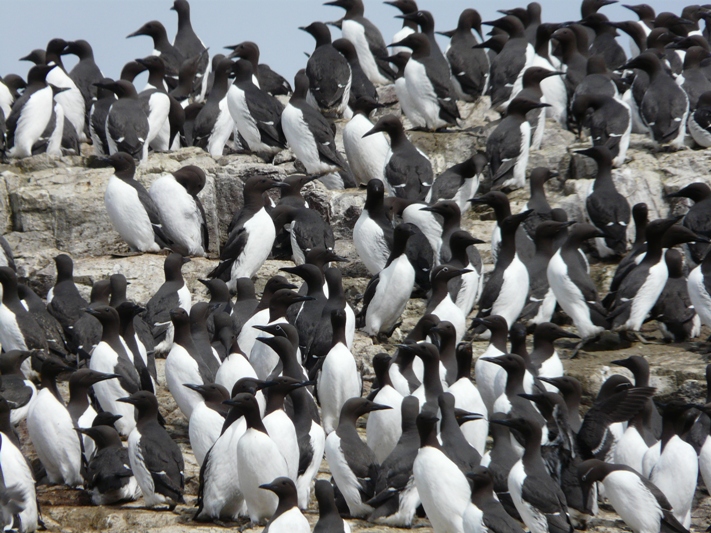
Sunday 9th September comments: In the next seabird instalment, here is a review of the Guillemots on the Farne Islands from this season: Guillemots are a unique species of the northern hemisphere, as they do not construct nests as breeding pairs lay a single egg and incubate with the egg balanced between their feet (as in the way of Penguins!) This makes counting very difficult and therefore a colony is counted as a total number of ‘individuals’ present, rather than the number of exact breeding pairs. This overall figure still gives us a very good picture of the health of the colony and the general trends between years.

This year a total of 49,076 individuals were counted as being present on the cliffs of the Farnes, an increase of 2.3% on the previous year. This represents a record population count and they have come along way since the first resident National Trust rangers were put on the islands in 1971, when the population stood at a mere 1,349!

The following figures represent the total number of individual breeding birds present on the islands with the bracketed figures representing the totals for the previous season: Inner Farne 6,784 (6,823), West Wideopen 2,232 (2,134), East Wideopen 3,096 (2,739), Megstone 420 (250), Skeny Scar 2,216 (2,672), Staple 23,665 (22,502), Brownsman 8,360 (8,547), North Wamses 1,317 (1,480), South Wamses 489 (440), Roddam and Green 97 (130), Big Harcar 400 (260),

As has been the case in recent years, the breeding season started quickly with the first eggs discovered on 10th April and the first young hatching from early May. Despite the weather (it was horrendous at times) the breeding population experienced a very good year (bucking the trend of many east coast seabird colonies) as huge numbers of young departed the islands from mid-June to early July. It was estimated that over 20,000 young fledged the Farnes representing a very healthy return.

As for next year, will the Farnes topple the 50,000 individual mark for the first time and fingers crossed for even more breeding successes. If you're a Guillemot, the Farnes is the place to be!